Discover Yahoo! With Your Friends

Explore news, videos, and much more based on what your friends are reading and watching. Publish your own activity and retain full control.

To get started, first

YOUR FRIENDS' ACTIVITY

    11 things you should buy organic
    Getty ImagesGetty ImagesBy Sara Reistad-Long

    By now, we all know there's a benefit to buying some stuff organic. But these days you're faced with the option of getting everything organic-from fruits and veggies to mattresses and clothing. You want to do right by your body, for sure, but going the all-natural route en masse can be pricey.

    So we wondered: What's really essential for our health? That's why we came up with this definitive list. Here's what should be in your cart-and what you don't have to worry about.

    Beef
    You've probably read plenty of stories about the risks of eating chicken. But the most important protein to buy organic may well be beef. "Research suggests a strong connection between some of the hormones given to cattle and cancer in humans, particularly breast cancer," says Samuel Epstein, MD, professor emeritus of environmental and occupational medicine at the University of Illinois at Chicago School of Public Health. Specifically, the concern is that the estrogen-like agents used on cattle could increase your cancer risk, adds Ted Schettler, MD, science director at the Science and Environmental Health Network.

    Though there are strong regulations about the use of hormones in cattle, "not all beef producers are following those regulations strictly, and some studies continue to find hormone residue in cattle," Dr. Schettler says. When you buy beef that's been certified organic by the United States Department of Agriculture (USDA), you're not only cutting out those hormones, you're also avoiding the massive doses of antibiotics cows typically receive, which the USDA says may lead to the development of antibiotic-resistant bacteria in people.

    Health.com: 10 types of food that can make you sick

    Strawberries
    Strawberries may be a superfood-but they pose a potential risk unless you go organic. In addition to having up to 13 pesticides detected on the fruit, according to an Environmental Working Group (EWG) analysis, conventional "strawberries have a large surface area and all those tiny bumps, which makes the pesticides hard to wash off, so you're ingesting more of those chemicals," explains Marion Nestle, PhD, a professor of nutrition and public health at New York University and author of What to Eat.

    If you can, also skip conventional peaches, apples, blueberries, and cherries, which are typically treated with multiple pesticides and usually eaten skins-on.

    Cookware
    Your pots and pans are just as crucial to upgrade as the food you cook in them: "Most nonstick cookware contains a fluorochemical called PTFE that breaks down to form toxic fumes when overheated," says Olga Naidenko, PhD, a senior scientist at the EWG. "Those fumes can coat the inside of the lungs and cause allergy-like symptoms."

    Tests commissioned by the EWG showed that in just two to five minutes on a conventional stove top, cookware coated with nonstick surfaces could exceed temperatures at which the coating emits toxic gases. Switch to stainless steel, ceramic, or cast iron cookware.

    Health.com: 11 kitchen tools that keep you thin

    Popcorn
    The linings of microwave-popcorn bags may contain a toxic chemical called perfluorooctanoic acid, or PFOA, which is used to prevent the food from sticking to the paper. According to the Environmental Protection Agency (EPA), PFOA is a likely carcinogen. "We don't know all of the hazardous effects of PFOA yet, but we have some evidence of a link to cancer, as well as to effects on the immune, nervous, and endocrine systems," says David Carpenter, MD, director of the Institute for Health and the Environment at the University at Albany.

    Pick up an air-popper or make your popcorn in a pan on the stove top.

    Yard pesticides
    Some lawn and garden pesticides contain suspected carcinogens, according to EPA data. Long-term pesticide exposure may be related to changes in the brain and nervous system, the Fred Hutchinson Cancer Research Center reports. "Not only are you breathing the chemicals in, but you bring them indoors and onto carpets via your shoes," says McKay Jenkins, PhD, a journalism professor at the University of Delaware and author of What's Gotten Into Us?

    Healthier brands like BurnOut and EcoClear are made from vinegar and lemon juice, and are effective weed-killers.

    Heatlh.com: 10 dirty fruits and vegetables

    All-purpose home cleaners
    Time for spring-cleaning? Using common household cleaners may expose you to potentially harmful chemicals. Ammonia and chlorine bleach can irritate the skin, eyes, and respiratory tract. And some cleaners contain phthalates, some of which are endocrine disruptors, meaning they interfere with normal hormone activity, says EWG senior scientist Becky Sutton, PhD.

    Although there's no definitive proof that phthalates cause problems in humans, "the greatest concern is how early-life exposure will affect male [reproductive] development," Dr. Carpenter says. There's weaker evidence, he adds, that phthalates affect the nervous and immune systems. Go natural with the cleaner you use the most frequently and in the most places, such as kitchen-counter spray-look for brands approved by Green Seal or EcoLogo, two organizations that identify products that have met environmental label guidelines.

    Health.com: Green guide to cleaning

    Water bottles
    You've probably heard that many hard, reusable plastic water bottles could be bad for you because they may contain BPA, or bisphenol A, another endocrine disruptor according to the National Institute of Environmental Health Sciences.

    "For adults, the biggest concern with BPA is that it may increase the risk of breast cancer in women and reduce sperm counts in men," says Dr. Carpenter, who explains that BPA can leach out into the water in the bottle. To be safe, sip from an unlined stainless steel or BPA-free plastic bottle.

    Food-storage containers
    BPA strikes again: Many food-storage containers are made of the hard, clear polycarbonate plastic that may contain BPA. As is the case with water bottles, the BPA can leach out of the plastic in these containers and seep into your leftovers.

    Health.com: Studies report more harmful effects from BPA

    "The leaching is increased during heating, but it also leaches to a smaller degree even when cold foods are stored," Dr. Carpenter explains. Glass containers are your safest-not to mention planet-friendly-bet. Both Rubbermaid (at left) and Pyrex make glass ones with BPA-free plastic lids.

    Milk
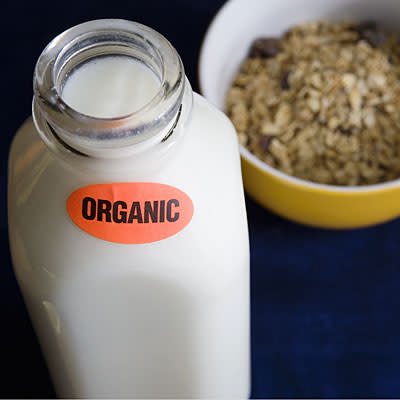
    The milk you're drinking may not be doing your body good: Dairy products account for a reported 60 to 70 percent of the estrogens we consume through our food. If that seems like a shockingly large number, it's mainly because milk naturally contains hormones passed along from cows. What worries some experts is that about 17% of dairy cows are treated with the hormone rBST (or rBGH), which stimulates milk production by increasing circulating levels of another hormone called insulin-like growth factor (IGF-1).

    "Elevated levels of IGF-1 in people are associated with an increased risk of cancer, including breast cancer," Dr. Schettler explains. In fact, the use of rBGH is banned in Europe and Canada. Although research has yet to definitively conclude whether drinking rBGH-treated milk increases your IGF-1 levels high enough to cause concern, Dr. Schettler says it's advisable to buy milk that hasn't been treated with it. So pick up milk that's labeled rBGH-free, rBST-free, or is produced without artificial hormones.

    Health.com: 11 healthy milk shakes and smoothies

    Celery
    When researchers at the EWG analyzed 89,000 produce-pesticide tests to determine the most contaminated fruits and vegetables, celery topped the chart. "In terms of the sheer number of chemicals, it was the worst," says Sonya Lunder, senior analyst at the EWG. Celery stalks are very porous, so they retain the pesticides they're sprayed with-up to 13 of them, according to the EWG analysis. Lunder also advises buying organic bell peppers, spinach and potatoes because they scored high for pesticides, as well.

    Tomato sauce
    When picking up tomato sauce or paste, choose the glass jar or box over the can. "The lining on the inside of food cans that's used to protect against corrosion and bacteria may contain BPA," explains Cheryl Lyn Walker, PhD, a professor of carcinogenesis at MD Anderson Cancer Center and past president of the Society of Toxicology.

    In 2009, Consumer Reports tested BPA levels in a variety of canned foods and found it in nearly all of the brands tested, suggesting that the chemical leaked in. "What can happen is that BPA in the lining can leach into the food," Walker explains.


    474 comments

    • zilverenmist  •  11 months ago
      Milk shoud be raw to give any benevit. Coming from any factory it loses its force.
      Raw milk contain important vitamins B, these are lost in the proces of fat separation,pasteurisation and sterilisation.
      It is redicilous that what nature gives for free is more expensive than fabriced stuff.
      So thanks to the financiers we eat unhealthy, to preserve their provids.
    • that-which-is-i  •  1 year 1 month ago
      "Posted by Bill Tue Apr 5, 2011 3:56pm PDT

      Organic, how did people live to be 100 without Organic foods? Just rinse you fruits and vegetables and you can live to 100 years old. "

      dissecting this statement.. .lets see.. 100 years ago super chemicals did not exist. we got rid of pests by other means. we used real fecal matter as fertilizer.. so basically, everything WAS organic back then, especially if referencing someone who is now 100... the sad thing is that we even have to REVERT BACK to differentiating between organic and non, because everyone is out to make supplies stretch to make more money with less product, even at the cost of others' lives and health.
      please everyone stop being so arrogant to one another, using words like morons and do gooders.. who is that going to help? it makes you look like a hypocrite.
    • NunYa  •  1 year 1 month ago
      Im with you Dr. Bill !!!!! I'll bet over half of these people on here couldn't tell the difference between the two in a taste test or by looking at them without the word ORGANIC on the label!!! J had a good point as well about the fact that they are trying to shove this whole ORGANIC mess at everyone.. I can fool my girlfriend and she is in the medical field and buys ORGANIC all the time.. Its a name like you find on clothes or the fancy little cars you putt around in people, you buy it to fit in with the rest of your kind.Me, I'm all about "Earth First, We Can Log The Rest Of The Planets Latter"..Excuse me while I jump into my SUV and find me some Hippies,"Now I'm Done"
    • sharlene  •  1 year 1 month ago
      This would be more probable if organic foods weren't so damn expensive! I know the land usually takes about 3 years or more until you can start producing organic products but if you don't have a decent budget, you're going to spend a large amount of money for a small amount of product.
    • 진석  •  1 year 1 month ago
      섹지식in 공지사항 http://ktv79.godco.kr/
      섹지식in 공지사항 http://ktv79.godco.kr/
      섹지식in 공지사항 http://ktv79.godco.kr/
      섹지식in 공지사항 http://ktv79.godco.kr/
      섹지식in 공지사항 http://ktv79.godco.kr/
      섹지식in 공지사항 http://ktv79.godco.kr/
      섹지식in 공지사항 http://ktv79.godco.kr/
      섹지식in 공지사항 http://ktv79.godco.kr/
      섹지식in 공지사항 http://ktv79.godco.kr/
      섹지식in 공지사항 http://ktv79.godco.kr/
      섹지식in 공지사항 http://ktv79.godco.kr/
    • Jim & Nancy D  •  1 year 1 month ago
      Well, to be sure, if all farmers were to raise only "organic" foods there would be plain and simply a shortage of food. Sooooo, we must pick and choose what we as a people choose the organics that we can live with; perhaps like the fruits and vegi where the pesticides are sprayed directly on the product. IE potatoes which are grown subteranially have the above ground plant, not the tuber, sprayed to insure it's survival. Did you know that the Irish potato famine KILLED more people from eating blighted potatoes than from starvation. You see, the plant must be protected from pests and diseases in order to have edible potatoes. You and I need to learn more.
    • Broketaxpayer  •  1 year 1 month ago
      I'd just be happy if the produce we bought didn't have human feces on it.
    • Sami  •  1 year 1 month ago
      awesome info
    • TAVIUS  •  1 year 1 month ago
      i luv it giv me more info websites etc
    • Nicole  •  1 year 1 month ago
      I like organic and I try to buy as much of it as I can mainly because I know how much hard work goes into keeping all of these products that way. Everyone I've talked to about this subject seems to have a different story. I've talked to doctors who have been in study groups at hospitals as well as people who have done all of the research on it and have been told otherwise regarding the hormones. A lot of people's concerns aren't based on the fact of cancer like this article is pointing to, but the mere fact of how many young girls walk around big chested and hit puberty a lot earlier.... I do believe it is healthier to go towards organic because there are natural preservatives in a lot of these products and everything seems to be lighter. I believe everyone should witness how organic farmers work their farms as well as regulary dairy/beef farms and compare the two... It has opened my eyes to see all the hard work that goes into it but also opened my eyes to see exactly how the cows are treated (medically). I am a licensed veterinary technician and have been to both of these kinds of farms with doctors. I have seen treatment plans and they do have regulations. Everyone thinks that these cows are just pumped full of antibiotics anytime something happens to them and the truth is they do what they can to get by without. It is the very last option for them to treat with antibiotics when the cows are being milked. If they do treat them with antibiotics they have a certain amount of waiting period afterwards before that cows milk can be added to all the rest of it. Whether or not the farmers are following those rules, who knows. However, I do appreciate the fact that these organic farmers work so hard to keep us healthy.
    • Joyce  •  1 year 1 month ago
      I have also learned you should stay away from corn unless it is organic because most is generically modified which is also not good for you. It is so hard to stay healthy when the government makes the farmers grow food that is not good for you.
    • A Yahoo! User  •  1 year 1 month ago
      In regards to fruits in vegetables, if you eat the skin then go organic. Funny how if we produced food like we did a 100 years ago, all natural and organic. We would probably cut peoples cancer risk by 75%. The not so natural chemicals we put in our bodies is what is making us sick.
    • britt  •  1 year 1 month ago
      Eating dead decomposing flesh is never good for you, organic or not. Neither is fatty cow's milk, organic or not. But the microwave popcorn was new to me.
    • tasha  •  1 year 1 month ago
      Very informative, thank you soooo much for spreading the good news.
    • MW35215  •  1 year 1 month ago
      Wow, this article only cites one "expert" who just happens to work for a group who want to scare people into using only the products they endorse........'

      I would be more inclined to want to go organic if you could get a mainstream expert on your side.
    • NoahR  •  1 year 1 month ago
      im glad to see the FDA is still doing a bang up job making sure americans are safe... oh wait, they're still taking bribes from big business so that they can save money at the cost of consumers lives.
    • JoAnn  •  1 year 1 month ago
      What I don't understand is that I keep reading these stories about links to cancer, and I wonder: why are we still allowing these foods to be treated in this way? If these things pose such a great risk (as noted by researchers and University professors), then why allow these processes to continue?
      Shouldn't all food by default be organic? The price of food shouldn't be based on chemical count.
    • Susan  •  1 year 1 month ago
      No J, they don't think you'll grow another body part. They KNOW that you'll get cancer of some sort from all the pesticides if you keep eating non-organic, canned, and microwaveable plastic bag/container food.
    • Tim  •  1 year 1 month ago
      One of the interesting omissions was the source of the meat, milk, fruit and vegs covered in the article. Pesticides are approved at the national and state levels. Food from other countries can use pesticides band in the USA and some states have strictor presticide limitations than the federal standard. It would sure be nice if we had country of origin labeling and even labeling that cover growth hormones in beef and BST in milk. I happen to believe in feeding the world and unfortunately organic farming is not going to be able to meet US needs let alone the world food need. I also believe we need a safe an tracable food supply. Unfortunately the US agricultural industry (big corporate farms) does not believe in tracability do to liability and cost issues. Maybe one day people will stand up and require tracability, but until then, the only way is going organic (I call it more bugs and slugs path).
      v/r
      Tim
    • just a guy  •  1 year 1 month ago
      catherine it is time you grow your own food, start a hobby plant an organic garden. j is like most of the people in this country just want to go threw life uninformed and ignorant to whats really going on.

    Join us on Pinterest

    DAILY SHOT VIDEO

    We apologize. An error has occurred. Please try again.