Discover Yahoo! With Your Friends

Explore news, videos, and much more based on what your friends are reading and watching. Publish your own activity and retain full control.

To get started, first

YOUR FRIENDS' ACTIVITY

    Salad Spinner Centrifuge: A Cheap, Ingenious Health Care Tool
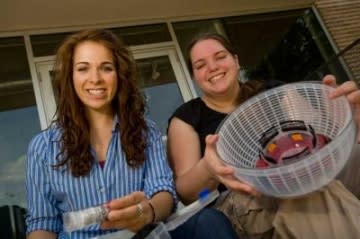
    We already know that we need to eat plenty of leafy greens to stay healthy, but who knew that a salad spinner itself could help save lives?

    As we learn from EurekAlert, Rice University undergraduates Lila Kerr and Lauren Theis were presented with an assignment in their Introduction to Bioengineering and World Health class. As Theis explains:

    "We were essentially told we need to find a way to diagnose anemia without power, without it being very costly and with a portable device."

    In a solution short on cost but long on ingenuity, the duo modified a basic, everyday salad spinner into an easy to use and transport centrifuge that successfully separates blood to allow diagnosis of anemia with no electricity. The device costs about $30, can process 30 individual 15 microliter blood samples at a time, and can separate blood into its component red cells and plasma in about 20 minutes.

    "Sally Centrifuge," as the innovation has been dubbed by its creators, is undergoing a series of field tests this summer in places that will benefit from the availability of effective but low-tech solutions and adaptations. As part of Rice University's Beyond Traditional Borders (BTB), a global health initiative focused primarily on developing countries, Kerr and Theis are traveling along with their device to Ecuador, Swaziland and Malawi, where rural clinics will provide real-world testing of the surprising diagnostic tool.

    In rural, under-served and impoverished parts of the world, a positive diagnosis for anemia is a critically important clue when looking for other health problems such as malnutrition, or serious chronic infectious diseases such as malaria and HIV/AIDS. Until now, blood samples taken in the field would have to be sent to a distant location complete with expensive laboratory centrifuges and electricity, while patients would be left waiting for the results - a lapse in time that can be deadly. Being able to diagnose the condition in real time with "Sally Centrifuge" would allow appropriate treatment to begin before before an illness progresses and a patient's condition deteriorates too drastically.

    Maria Oden, engineering professor and co-adviser to the team, reflects on how successfully the two young women approached the assignment by providing something that may literally save lives as it is brought to bear on pressing health challenges in rural and economically under-developed regions of the world:

    "The students really did an amazing job of taking very simple, low-cost materials and creating a device their research shows correlates nicely with hematocrit levels in the blood. Many of the patients seen in developing world clinics are anemic, and it's a severe health problem. Being able to diagnose it with no power, with a device that's extremely lightweight, is very valuable."

    Have an innovative idea for re-purposing a household gadget yourself? Share it in a comment below!

    Read more Weird Science stories at Tonic!


    -David Bois
    Photo by Jeff Fitlow/Rice University.


    Top Locations Chennai

    1,966 comments

    • CHRIS I  •  5 months ago
      How creative this is. Great idea ladies. Keep those brains ticking.
    • jorge31663  •  5 months ago
      This is hardly new - Army field hospitals have used hand cranked centrifuges for blood work for decades. Much better to get some of those robustly constructed items than flimsy plastic salad spinners.
      • MYOB 3 months ago
        The concept of a manual centrifuge is not new but commercially available units are expensive and have lower capacity. E.g. the Hettich model 1011 that can only handle 4 samples costs around $300 while we are told that this can handle 7.5X the samples for 1/10 the cost. What is impressive is how they have recognized the potential of an everyday, mass-produced, object and adapted it at minimal cost.
    • Jone Jone  •  1 year 1 month ago
      good article !
      http://guidediet.info is website about diet and nutrition. You can find useful information in this website
    • dan  •  1 year 8 months ago
      DIY ACUPUNTURE WITH YOUR OLD COMPUTER KEYBOARD
      No Practitioner is needed
      Stimulation of points in your fingers leads the body in harmony with
      my fractal software and the keyboard lead you to oneness Recycle your old keyboard now with the Zako pressure keys.
    • Mona  •  1 year 8 months ago
      testing spam :i love this article. good luck!
    • Robert  •  1 year 10 months ago
      Great invention but last time I gave blood the nurses put a drop of my blood into a vial right there to check for anemia. It would float or sink as part of the test. I'm I mistaken? Rob
    • Maur  •  1 year 10 months ago
      Ladies, Ladies,Ladies...you make your country proud. You are the very reason why so many people from around the world long to be a part of this country. Sheer brilliance !!!
    • Supawadee  •  1 year 10 months ago
      wow, and all along I thought someone would use a bicycle wheel as a centerfuge. DOH!
    • Woodsy011  •  1 year 10 months ago
      A great idea that will be taken over by a medical equipment company. The company will manufacture them for $30.00, then sell them for $1500.00, blaming research costs to justify that ridiculous price
    • Bill  •  1 year 10 months ago
      I Applaud those two ladies for using their brain.
      So few ever have an original thought and these lovely ladies not only had an original thought but are helping the world with it. Now why is this not the norm? Could it be because most of our schools try extra hard to make us all the same? HMMM

      Ladies you have wonderful brains, continue to use them your way..............
    • john  •  1 year 10 months ago
      nobel prize !!!!!!!!!!!!!!!!!!!!!!
    • mary  •  1 year 10 months ago
      way to go future doctors.
    • Hobbit  •  1 year 10 months ago
      I hope they're getting a scholarship or grant of some kind. I'm sure they'll have some lucrative offers for graduate school.
    • Ade  •  1 year 10 months ago
      Such excellent engineering piece should be used at Johns Hopkins or Harvard.

      We absolutely and positively don’t want it in Africa. If UPenn don’t want it, we don’t want it. Thank you.
    • mike  •  1 year 10 months ago
      what about india can you travel to india to introduce your device there are lot of people they need money saving device
    • Ivette  •  1 year 10 months ago
      What a wonderful idea. aaaaaaaaayou will help so many people. I hope you'll come to the Philippines!
    • LindaN  •  1 year 10 months ago
      Great job! Let's hear more about the other projects.
    • Batgirl  •  1 year 10 months ago
      Great item - people like this are needed. Well done ladies - inspirational :)
    • Mark  •  1 year 10 months ago
      Funny or sad that the most intelligent "scientist" didn't think about this, the salad spinner is a centrifuge in it's basic form, set a rack from a plasma centrifuge and give it a spin. Now that its a health care product, gotta make it with more durable "safer" materials and inflate the price x 10 to 100 and wallah, a field unit.
    • james  •  1 year 10 months ago
      RE: "My fantasy guru was actually my trainer for a time....and excellent! Unfortunately, I moved out of state, and away from him! Could use his expertise now!"

      What the hell are you talking about???

    Join us on Pinterest

    DAILY SHOT VIDEO

    We apologize. An error has occurred. Please try again.